Put Your Own Hair Up!: Female Agency in the Historical Kdrama

Source: http://www.hancinema.net/korean_drama_Merchant_Kim_Man_Deok-picture_115408.html?sort=Most_Popular_Pictures
Kim Man Deok, Merchant Kim Man Deok

For some, Kdramas may be the last place to look for empowered female characters, but I think they contain quite a lot of female agency.

Modern Kdramas sometimes draw feminist-inspired critiques for their representations of women.   On Outside Seoul, Amanda sets up a tension between feminist ideals and Kdrama:  “I’ve always considered myself to be a feminist, which can be a difficult thing to reconcile with a love of Korean drama. As much as fun as I have watching these shows, I often find myself cringing when it comes to their depictions of relationships between men and women.”

Theresa Celebran Jones tentatively approaches her critique of Kdramas because of her unfamiliarity with the cultural context, but defines herself as a “feminist since my early teens,” which causes her to give the genre of romantic comedies the side-eye:  “Even then I knew that romantic comedies had a tendency to reinforce traditional gender roles and set unrealistic expectations for relationships. Too often, I felt romcoms cosigned behavior that would come off creepy or be otherwise unacceptable in real life.”  Her assessment of A Gentleman’s Dignity was not without critique:  “A lot of wrist-grabbing, possessive boyfriends, and stalker-like behavior, and this was a show that completely favored the male perspective.”

While Amanda admits that “feminism is a weirdly fraught topic in America,” she does not elaborate. One of the reasons why feminism is complicated is because there are actually several brands of feminism, including black, postcolonial and third-world feminisms.  These brands of feminism recognize that race and nationality can impact what agency and equality mean to different women. One of the critiques these feminists express is the notion that early brands of feminism were defined by what white women wanted, which may be different from what women of color want.  For feminists of color, the issue may be more about choice rather than a predetermined equality.

With that said, one may be able to see feminist tendencies in Kdrama that are overlooked if we only view feminism through a white feminist lens.  Women have different opinions of what agency looks like. Kdramas may in fact promote agency by Korean women that may not look like agency to women measuring their behavior by Western mainstream feminist standards.  I’m an American woman looking at Kdrama, so like Amanda, I don’t have a full understanding of the cultural context either. But what I do see are women, even under patriarchy, making decisions for themselves.

Both Amanda and Jones focus on contemporary Kdramas, but I find a lot of female agency in a place one might least expect it: the historical Kdrama, or sageuk. I’m currently watching Merchant Kim Man Deok, and Kim Man Deok (also known as Hong as a young girl) may be subject to certain expectations of women in Joseon-era Korea, but there are significant instances where she exerts her agency.

Generally plucky,  Man Deok finds herself as a government gisaeng on Jeju Island. The time comes for her to have a man “put her hair up.”  The gisaeng headmistress explains that the man who “puts a woman’s hair up” becomes like a husband to her. Man Deok does everything she can to avoid the ceremony.  Even though she knows Kang Yoo Ji, the foreman of a local merchant company who is attracted to her, she does not want to have that kind of relationship with him. During the elaborate processional to the ceremony, Man Deok looks like she’s going to the gallows.

As is typical of a melodramatic Kdrama, circumstances occur that postpone the ceremony, and Yoo Ji never “puts her hair up.”  But what is interesting is that a few episodes later, Man Deok makes a point of telling her father that she “put her own hair up,” which seems to suggest that she does not belong to a man. This act seems to signify  not only a certain maturity, that she is a young woman rather than a teenager, but also that she is not dependent on a man.

Source: http://www.hancinema.net/korean_drama_Merchant_Kim_Man_Deok-picture_113134.html?sort=Most_Popular_Pictures
Kim Man Deok, Merchant Kim Man Deok

Man Deok continues to show independence when she rejects the aggressive courtship tactics of Yoo Ji. After failing to be the man to “put her hair up,” he continues to pursue her. Following the faulty advice of his scheming stepmother, he initially withholds evidence of Man Deok’s commoner status, which can allow her to be dropped from the government gisaeng rolls. At first, he intends to exchange it for her “being his woman.”

When that fails, he works with his stepmother to try to destroy East Gate, the merchant company for which that Man Deok works.  When they succeed in falsely accusing the East Gate head foreman of smuggling illegal goods and economically crippling the company, Yoo Ji offer to “save” Man Deok. When she refuses, he tells her that he will destroy any company she works for until she relents. Not only does she tell him she would rather jump in the ocean than be his woman, she asserts that she will not join another company but build East Gate back up with her own hands.

It’s easy to root for a character like Man Deok; she’s so likeable and plucky. It’s harder to root for a female who goes against societal expectations in a way that hurts others but exerts the same degree of independence.  I have to admit, Choi Song Yi is relentless in God of War.  She falls in love with Kim Jun, a slave, and after helping him advance through the military, she drops the bomb on her father that she wants to marry him. Because her father, Choi Woo, the supreme military commander, wants an heir to succeed him, he’s not going to let that happen.

You would think she would just let it drop. But no!  She engineers a plan to run away with Kim Jun, but he’s not having it.    When forced to marry another man to satisfy her father’s wishes, she continues to hold a torch for Kim Jun, right up to when she meets her demise.  While she doesn’t murder anyone with her own hands, her inaction contributes to the death of at least four people.  I have to admit, when she was alive, she was not my favorite character. In fact, I thought she was not right in the head.
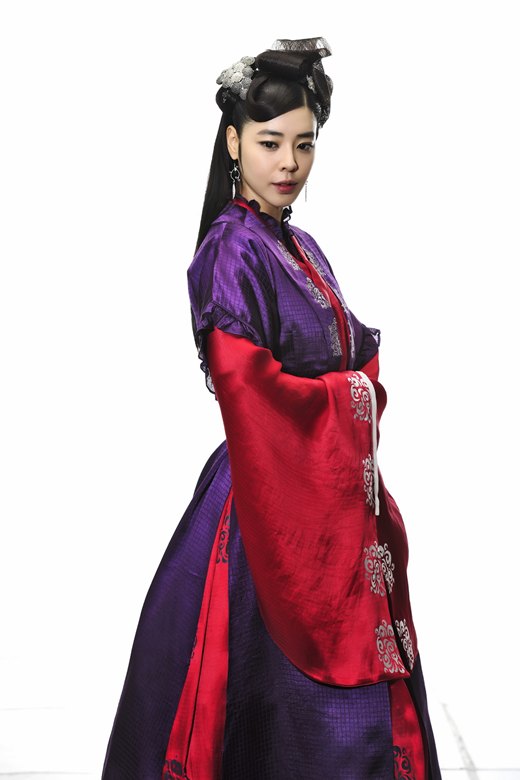
Source: http://www.hancinema.net/korean_drama_God_of_War-picture_219109.html?sort=Most_Popular_Pictures&typephoto=promotion
Song Yi, God of War

But during her last episodes, I realized that she defies her father and societal convention, up to the end. Her impassioned pleas to her father and mother about her love for Kim Jun suggests an unwavering desire to flout societal expectations.  She explains that she is willing to give up her wealth and position to be with him. While one could argue that she’s a stereotypical woman who does anything for love, Song Yi actually is little more savvy than that. Kim Jun is her man, so while he spurns her affections (every time!), she also looks out for his political future.  She even chastises her father for failing to free Kim Jun earlier and give him more responsibility.   She routinely tells her father than Kim Jun is the man he can depend on, unlike the flunkies that surround him. Finally,  she is so confident in her actions,  she never shows remorse, even when she knows it’s wrong, even at the end.

I may not like her choices, but Song Yi boldly makes them and she accepts the consequences of her actions.  In doing so, she consciously challenges societal convention, and while she does not make it to the end of the series, even the soldiers marvel at her will.

To me, agency is about women making their own choices, even in situations where they are limited, even when we don’t agree with them. They are still their choices, and isn’t that what feminism is about?

Images

Merchant Kim Man Deok,1, 2,  Han Cinema.

God of War, Han Cinema.

Sources

Amanda.  “The Other F Word: Feminism versus Korean Drama.”  August 21, 2012.  Outside Seoul. Accessed September 30, 2012. <http://outsideseoul.blogspot.com/2012/08/the-other-f-word-feminism-versus-korean.html>.

Jones, Theresa Celebran.  “A Primer on K-Drama Feminism.” September 12, 2012.  Hyphen.  Accessed September 30, 2012. <http://www.hyphenmagazine.com/blog/archive/2012/09/primer-k-drama-feminism>.

Talking to @BlackNerdJade About KPop and Its Reign In America…#GangnamStyle

See on Scoop.itKorean Wave

This is probably one of the best overviews of the appeal of Korean popular culture to Americans who are, as @BlackNerdJade puts it, those “in the know.”  


This shows that the Kpop subculture in the United States is fairly diverse, and the article identifes some of the things that American fans of Kpop and Kdrama find appealing.


There is the perennial question of “Will K-pop Crossover in the United States,” and I agree that YG may have greater appeal for mainstream America because it is so much like mainstream American music. However, many fans of K-pop like it precisely because it is not like contemporary American music, and as a result, may not be thrilled with only being offered more of what they already get on the American music scene.

See on drhiphop85.com

The ‘Korean Invasion’: This is Just the Beginning

See on Scoop.itKorean Wave

This article takes some liberties with the history of Hallyu, conflating its East Asian and global spread and contributing to the narrative that Psy’s international fame is completely unrelated to the Korean agencies that produce such idol groups as Super Junior and solo artists like Rain.


This article does not make distinctions between Hallyu’s engagement in East Asian countries like Japan, which is several years old, and its engagement with Europe, Central and South America, and the United States.  


Psy strikes many who are unfamiliar with K-pop as different, but what happens at a Psy concert isn’t that much different than what happens at a Super Junior concert.  Even more amazingly, the article contends that “Though he is managed by YG Entertainment, the fact that he was managed by them did not contribute to his success.”  That is hard to believe, as Psy is a member of the label, has toured with the YG Family (other artists on the label) and features some of those artists in his video for Gangnam Style.


Psy’s experience is very different from Jang Geun Suk, who has practically taken up residence in Japan, but remains virtually unknown beyond East Asia.

See on www.kpopstarz.com

If I Go to Korea …..

See on Scoop.itKdrama

This post by Ade reveals how Kdrama impacts international viewers’ interest in Korea. 


Ade is a 19-year-old muslim young woman who studies Pharmacy at Islamic University in Indonesia.


Ade states that one of the things she wants to do in Korea is see the Gyeokbokgung and Deoksugung palaces, and that she loves sageuk dramas.


Often, people think that it is the modern Kdramas that draw viewers interest in Korea, but the historical dramas are also appealing, as people are drawn to Korean historical figures and places.

See on viprimadoona.wordpress.com

Hallyu Tsunami: The Unstoppable (and Terrifying) Rise of K-Pop Fandom

See on Scoop.itKorean Wave

Sam Lansky’s account of his interaction with K-pop reads like bad fan fiction, and perpetuates the idea that K-pop fans are lunatics who over-react when it comes to their favorite groups.


One of the biggest misrepresentations found in the piece is his assertion that that K-pop fans in the United States are made up “mostly the ken of geeky music journalists, Asian Americans, and gays weary of Lady Gaga’s art-pop pretensions but thirsty for a similar spectacle.”  K-pop draws one of the most diverse fanbases of a musical genre, and many K-pop fans were fans before Psy’s Gangnam Style.


As one of the comments suggests, Lansky creates this story in part by egging on K-pop fans on social media.  While many of the younger fans of K-pop frequent Twitter, there are many who do not. Moreover, Lansky is fascinated by what he calls the “spectacle” of K-pop; he’s an outsider looking in and participating without making an effort to understand the fandom or represent a reasonably accurate picture of it.

See on www.grantland.com

Producer Steven Lee: “[The] Recent Global Phenomena of K-pop Brought A Lot of Foreigners”

See on Scoop.itKorean Wave

BTS Celebs talks to Steven Lee, a producer who frequently works with K-pop artists.  This is one of the few interviews that delves into those who are behind the scenes.


It gives some interesting backgound information, but the interviewer does not ask the one question I would ask, namely: how does he feel about criticisms about K-pop being manufactured and fake, as he spends so much time and energy in the studio creating the music?

See on btscelebs.wordpress.com

The rise of Eat Your Kimchi

See on Scoop.itKorean Wave

James Little gives in-depth insight into Simon and Martina, the couple behind the internet phenonemon, Eat Your Kimchi.  Soon after this story was posted, the couple began fundraising for their Eat Your Kimchi business through a video posted on YouTube on September 5, 2012, which also ran on their website.


By providing more details about the couple’s motives for doing what they do, the article does provide more context for the fundraiser. While the fundraiser video, post on EYK and description on Indiegogo all suggest that the couple needed the funds to support their business venture by renting a studio and paying for full-time video editor, the article quotes the couple as suggesting they are in fact financially set: “Simon and Martina freely admit that the website, and the businesses associated with the website, are now successful enough that they do not have to worry about the security of their livelihoods.”    Such discrepencies relate to comments on YouTube and in an allkpop forum, as well as posts on Tumblr and blogs (including a post on House of Hallyu, written by a colleague of mine), all of which question the manner in which the couple fundraised for the business. 


The inteview covers the development of the popularity of the couple, but overstates their importance to the international K-pop fandom.  EYK features humorous videos about K-pop, but it is far from being “the top source of information on K-pop in English.”  That would be Soompi, the oldest source of information about K-pop in English (the site began in the 1990s, concurrent with the rise of Hallyu K-pop).  allkpop would be a close second for the source from which English speakers receive news about K-pop. EYK do humorous skits, critique K-pop videos and provide informative insights into getting around Korea as a non-Korean. They do not provide a steady stream of information about K-pop.


Also, the piece participates in the misrepresentation of K-pop fandoms as crazed groups of teenagers who blindly follow their favorite groups and attack those who do not.   While there are numerous sites dedicated to individual K-pop groups, a cursory glance at the rules for many forums and sites explicity state that bashing of other groups are not tolerated.  


Moreover, there are several site in English that do what EYK claims to only do: criticize K-pop.  For example, Asian Junkie bills itself “as a place for a collection of individuals to mock, analyze, and satirize the comings and goings of the Asian entertainment world.”  


See on groovekorea.com

The Equivocal Ethics of Eat Your Kimchi

See on Scoop.itKorean Wave

KDK presents a comprehensive interrogation of the recent fundraiser by Martina and Simon of Eat Your Kimchi, as they seek to fund their business venture through donations from their fans. 

See on houseofhallyu.wordpress.com

Behind K-pop’s Pop: The Work of Fans

See on Scoop.itKorean Wave

Evan Ramstad devles into an often overlooked aspect of K-pop: fan activity. Ramstad focuses on services crucial to K-pop fandom, such as subtitling and translation.  However, it’s unclear how their activities function as a business and profit-making venture.  


Lyric translation is just the tip of the iceberg: fans are busy sharing information and photos about artists and groups, translating tweets and subtitling Korean shows.  International fans, often not allowed to join Korean fan clubs, have created communities around such activities.  Fans are often the best reposittories about information about K-pop, which is crucial given the amount of coverage, and sometimes misinterpretation, it receives.  

See on blogs.wsj.com

2NE1 Invades America: Behind the Scenes With the K-Pop Phenomenon

See on Scoop.itKorean Wave

Jeff Benjamin’s review of 2NE1’s performance, like others, positions the group as the forerunners in the race for K-pop to “make it” in the United States. His review focuses on what he calls “the spectacle,” and given his description, there seemed to be quite a lot of it at the show.  There is a lot of description of what he saw,less about what he heard.  


One thing I’m noticing about the coverage of 2NE1 is the focus on their gender.  Benjamin’s take highlights their gender by describing the ladies as “adorable” and “nymph-like,” both of which counter the prevailing image of 2NE1 is a bold, confident female group. 

See on www.billboard.com

Live Review: K-Pop’s 2NE1 at Nokia Theatre

See on Scoop.itKorean Wave

August Brown provides a more positive review of the 2NE1 concert than appraisals of the New Jersey show.  He does a good job of parsing his overview, taking care to define Hallyu and tailor his comments in terms of 2NE1’s potential success for the American mainstream.  


However, like many commentators with little direct knowledge of Kpop as a culture, he makes generalizations, forgetting that the music is part of K-pop.  For those who are K-pop fans, K-pop typcially involves the music, videos, variety shows, photo shoot and endorsements, and sometimes Kdramas.


2NE1, and in fact, several artists of YG Entertainment diverge from this pattern in K-pop (Osy notwithstanding).  Recently, YG apologized for not letting 2NE1 on Korean talk shows because they said the girls didn’t have the personality for it. At the same time, however, 2NE1 did have their own behind the scenes show.  It’s clear that YG wants its artists to go beyond what some consider to be typical K-pop, but in doing so, it doesn’t reap the same kind of loyalty that other groups gain.  


So, Brown’s overview of the performance reads more like an American concert rather than a K-pop one. This has its advantages and disadvantages. it’s probably good for YG looking to make the coveted splash in the American mainstream.  However, it subjects YG artists to the same kind of generaliations that some say drive them to other modes of music outside of the American mainstream.

See on www.latimes.com

Asadal: 10 dramas to avoid (if you don’t want to hate Kdramaland for …

See on Scoop.itKdrama

This is an interesting list of Kdramas to avoid, many of which are key to their genres, especially fusion sageuk fusion and melodrama.  In fact, it is fairly atypical of individuals who write about Kdrama on the Internet. Personal preferences aside, most sites supplement personal opinion with a review that is based on evidence from the Kdrama.

See on ethlenn.blogspot.fr

Korean Wave Expansion In Japan Threatened By Territory Issue | The Manila Bulletin Newspaper Online

See on Scoop.itKorean Wave

Jonathan M. Hicap writes about the latest collision of culturel and politics, where the dispute over the Dokdo islands has spilled over to Kpop celebrities.  The post recounts Siwon (of Super Junior’s) retweets of comments from the Blue House, as well as the impact on other Korean stars in Japan.


While those of us outside the region may look at the dispute with a degree of confusion, the other interesting element to this story is the Japanese response in relation to Korean cultural products. Dokdo provides only the latest circumstance for some Japanese to call for a crackdown and, in some cases, an all-out ban, on Kpop and Kdrama. Such calls, however, overlook the agency and opinions of those who consume such cultural production.

See on www.mb.com.ph

What Does Gangnam Style Mean For (The) US?

Source: http://koreanupdates.com/2012/08/22/psy-gangnam-style-music-video-1-on-itunes-us-chart/
Album Cover, Psy’s Best Sixth (2012)

The viral status of Psy‘s Gangnam Style has reached epic proportions. While some see it as an unprecedented K-pop crossover, others point to its social critique of conspicuous wealth in the South Korean district.  However, the tendency for American mainstream culture to accept stereotypical and reductive images of Asians also plays a part in Psy’s popularity. 

It’s hard to deny that the song has made an impact in media.  Psy’s video appeared at No. 25 on Billboard’s Social 50 chart, which “ranks the most popular artists on YouTube, Vevo, Facebook, Twitter and MySpace, using a formula that blends weekly additions of friends/fans/followers along with weekly artist page views and weekly song plays.”  Such popularity also made Psy a fixture in American media, earning a mention on CNN as well as write-ups in major publications such as The Atlantic (more on that later).

In addition to appearing at Dodger Stadium, Psy appeared on VH1’s Big Morning Buzz Live show to teach the dance to the hosts. In addition, the popularity of the song put him in conversation with American music celebrities.   Yang Hyun Suk (the YG of YG Entertainment) sees Psy’s success as an opportunity:  “Regarding the love call from the international pop sensation Justin Bieber, the founder of YG responded, ‘We cannot reveal all the details yet, but an amazing collaboration project is in progress so please look forward to it.’

While some marvel at this popular cultural moment, others seek deeper meaning for Psy’s song in its social critique. Sukjong Hong writes:  “PSY does something in his video that few other artists, Korean or otherwise, do: He parodies the wealthiest, most powerful neighborhood in South Korea. . . . Ultimately, by declaring “Oppa is Gangnam Style,” he turns the lens on Gangnam, getting specific about power and privilege in a country where a single district has long dominated in almost every arena.”  Max Fisher credits Psy as unique in K-pop:   “Park Jaesang isn’t just unusual because of his age, appearance, and style; he writes his own songs and choreographs his own videos, which is unheard of in K-Pop. But it’s more than that. Maybe not coincidentally, he attended both Boston University and the Berklee College of Music, graduating from the latter. His exposure to American music’s penchant for social commentary, and the time spent abroad that may have given him a new perspective on his home country, could inform his apparently somewhat critical take on South Korean society.”

I find the Psy phenomenon in the America interesting, not because of what it says about Korea, but what it says about the United States.  Psy’s video did not enter a vacuum; it entered an American popular cultural consciousness that has a history with Korean popular culture in particular, and Asian representations in general.  One fan observes this history in a Tumblr entry,  “Asian Stars and The USA: A History.”  After listing BoA, Wonder Girls, Jin Akanishi, and Girls’ Generation, Asian artists who have been recognized for their talents and attained success in Asian countries but failed to enter the mainstream in the United States, the entry concludes with this observation:

Psy: lol omg guys watch me dance like a horsey.

USA: YES! EXCELLENT!

Psy: Wait what?

Psy’s video owes some of its popularity in the United States to the way the mainstream likes to portray Asian and Asian Americans in popular culture.  One of those ways is in comedic roles, where laughter comes at the expense of Asians and Asian Americans.  Chris Biddle writes about the tendency he sees in films like The Hangover and television shows like The Office:

Now I’m no kill joy, and admittedly am a fan of both the The Hangover and The Office, but while watching these scenes I couldn’t help but think about the fact that the Western audience seems like they just don’t take Asians seriously.  While hearing a French or Latino person speak English might suggest a kind of exoticism, an Asian person speaking English is downright goofy.  While on the outside this racial stereotype might not seem as malicious as some of the ones that Hollywood and broadcast television are guilty of, it nonetheless signifies a serious lack of respect for our Eastern counterparts.

What is missing from much commentary on Psy’s video is the existing American cultural context that embraces stereotypes of Asians while rejecting more realistic portrayals. When people ask why Psy’s video is so popular, this is one of the major issues that goes unanswered. I think more people are laughing at Psy than laughing with him.

The narrative that has emerged around Psy’s success in the United States also distorts the story of K-pop for audiences in the United States. Fisher misspeaks when he characterizes Psy as atypical of artists in K-pop, pointing to this as a reason for his success.  Psy has contemporaries who do the same thing.  At 34, PSY joins other older K-pop artists and groups with successful careers, some of whom debuted around the same time, including Kangta, Park Hyo Shin, Rain, Shinhwa, and Lee Hyori.  K-pop artists ranging from G-Dragon to TVXQ write their own material. Tablo of Epik High graduated from Stanford University.

K-pop has been engaging in socially-relevant issues from the beginning. While Seo Jung Min-gaph, a pop music critic, questions his ultimate impact, Seo Taiji, arguably the grandfather of K-pop, unquestionably engaged social issues in his songs:   “Seo was not only a dancer and musician, but was also an artist who delivered his messages directly to Korean society with his music.”  The narrative seems to be that Psy succeeds because FINALLY K-pop has produced something culturally significant that the United States can recognize. In actuality, Psy is not that different.  He’s not the only one by a long shot.

When thinking about what Gangnam Style means, we have to remember that it just doesn’t ride into an America that has not encountered Korean popular culture. The way we’ve been reading it says something about us in the U.S. as well.

Image: allkpop

Sources:

‘Gangnam Style’ Viral Video Sends Psy Onto Billboard’s Social 50 Chart,” Billboard

Psy Teaches His ‘Gangnam Style’ Horse Dance on VH1’s ‘Big Morning Buzz Live,’ allkpop

Yang Hyun Suk Discusses His Thoughts on Psy’s Global Success With “Gangnam Style,” allkpop 

Sukjong Hong, Beyond the Horse Dance: Viral Vid ‘Gangnam Style’ Critiques Korea’s Extreme Inequality,” Open City Mag

Max Fisher, Gangnam Style, Dissected: The Subversive Message Within South Korea’s Music Video Sensation,” The Atlantic

Cho Chung-un, K-pop Still Feels Impact of Seo Taiji & Boys,” The Korea Herald

Chris Biddle, The Asian Stereotype, Other Side of China

Video:

Psy Gangnam Style News US TV Appearance, YouTube

Creative Commons License
This work is licensed under a Creative Commons Attribution-NonCommercial-ShareAlike 3.0 Unported License.

Bijou Street: Thoughts on film: Chang Cheh is missing: searching out a great, little-known director

See on Scoop.itWuxia

This is a nice piece on Chang Cheh’s work.  He compares Chang Cheh’s aesthetic, which is quite violent, to the more aesthetic work of King Hu.  

See on bijoustreet.blogspot.fr