Ever so often, I like to share what’s on heavy rotation on my iPod. It isn’t always the newest thing, or the most popular thing, but for some reason this is the stuff that I’m grooving to.
What I’m Listening To
Hit Song by old skool Kpop group N.R.G.
How I Came to Listen to It
I can’t even remember. I think I was stalking around on YouTube looking for some old skool Kpop and found it.
Why I Like It
Um, ’cause it’s great! It’s got that disco vibe that I like so much. Really, it reminds you of when pop music was fun and upbeat. This is on HEAVY rotation on the iPod, as is its cousin, the “remix” on the album.
Wu Xia, directed by Peter Chan and starring Donnie Yen, Takeshi Kaneshiro and Jimmy Wang Yu, was worth the wait, and a welcome change from some of the mediocre wuxia films I’ve been seeing.
I am an avid watcher of Korean sageuk (historical Korean television series). They have something for everyone: romance, adventure, political intrigue, mystery. Little did I know that I was learning things along the way. Here are some of the things I’ve learned from watching sageuk!
Kpop is subject to a lot of criticism. A LOT. The most repeated charge against Kpop is that it is manufactured. But is that really true? Usually when critics level this charge, they make sweeping generalizations about the whole landscape of pop. In doing so, they perpetuate stereotypes about the lack of originality in Asian popular culture.
Kpop is subject to a lot of criticism. A LOT. The most repeated charge against Kpop is that it is manufactured. But is that really true? Usually when critics level this charge, they make sweeping generalizations about the whole landscape of pop. In doing so, they perpetuate stereotypes about the lack of originality in Asian popular culture.
It seems almost obligatory for anyone writing about Kpop to describe it as manufactured. Critics frequently focus on Kpop idol artists, who, in addition to making music, participate in other forms of entertainment, including variety shows and Kdramas, fashion shoots, endorsements and commercial films. In some ways it make sense. Idol artists dominate Hallyu, and tend to be the most visible to audiences outside of Korea.
But critics tend to describe all Kpop artists as manufactured. In defining Kpop on About.com, Bill Lamb writes, “As Western influences grew in Korean pop, the concept of the manufactured pop band took root as well.” Renie of Seoulbeats, in pondering whether or not K-pop is too perfect, writes: “Of course this all goes back to how idols are trained and manufactured.” Lucy Williamson of BBC News states: “K-Pop is expensive to produce. The groups are highly manufactured, and can require a team of managers, choreographers and wardrobe assistants, as well as years of singing lessons, dance training, accommodation and living expenses.”
These writers are not wholly wrong. Let’s be real. Given the number of Kpop groups in circulation and the kind of profits that can be made from even a moderately successful group, it is naive to believe their promotion is not deliberate. However, instead of qualifying their statements, critics suggest that it applies to every idol and all members of an idol group. Critics rarely name the artists against whom they level the charge, thereby qualifying their statements. As a result, calling all Kpop artists manufactured has resulted in negative connotations. At the heart of Kpop beats an artificial heart. Because the description is repeated so often without any challenge, it has become accepted as fact.The widespread idea that all Kpop is manufactured is surely a case of wikiality, coined by Stephen Colbert as truth by consensus, where “all we need to do is convince a majority of people that some factoid is true.”
Just because everyone says that Kpop is manufactured does not make it true. In fact, there is a strong case to be made that all Kpop is not manufactured. What does “manufactured” mean, and what do people really mean when they say that Kpop is manufactured? The Oxford English Dictionary, the grandaddy of dictionaries of the English language, defines it this way:
1. a. Of an article, goods, etc.: produced from raw material, esp. for sale or trade; b. Chiefly depreciative. Of a literary work, a speech, etc.: produced in a mechanical or formulaic way, with little or no creativity, imagination, or originality.
2. Of a story, statement, etc.: fraudulently invented or produced; deliberately fabricated, false.
When writers routinely describe Kpop as “manufactured,” they mean primarily two things: that Kpop idols lack talent, and that the process that creates Kpop is artificial and fake.
Wikiality “Fact” #1: Kpop idols lack talent.
To say that Kpop artists are manufactured suggests that the artists themselves lack talent, and in this way are “fraudulently invented or produced.” Renie suggests this when generalizing about idol trainees: “Trainees go in as a blank slate but come out as a product that can sing, dance, and sometimes act.” Similarly, Jangta makes a distinction between singers and entertainers using this spectre of fakeness: “Many mainstream K-pop groups today are actually strong at only three things. . . Unfortunately, singing isn’t one of them.” (Full disclosure: I am an assistant chief editor and editorial writer for hellokpop. Hey Jangta! :))
But is this true? Most people would agree that you cannot fake good singing. There is more than enough evidence to prove that many idols can, in fact, sing well. Because Korea still has a live radio culture, idols regularly sing on the radio, a place where they cannot rely on autotune or slick production tricks. I would imagine folk would regularly call in to complain about an idol’s inability to sing on the radio.
These aren’t even the hardcore idols singers, like Junsu of JYJ (formerly of TVXQ!), Yesung of Super Junior and Heo Young Saeng of SS501, individuals known for their voices. But wait, you may say, “Every group can luck up and have one person who can sing, but the others are just filler.” Are they? What do we make of groups that can harmonize, which suggests that all of them can sing?
The point here is that the sweeping generalization that all Kpop idols lack talent is contradicted by the actual landscape of Kpop.
Wikiality “Fact” #2: The training and production process of Kpop creates fake music.
To say that Kpop is manufactured also suggests that the music and the process that creates it lack “creativity, imagination or originality” and is therefore “artificial.” Such music is created through a process that is “mechanical or formulaic” because it is “produced. . . for sale or trade.” Renie writes, “It irks me that the industry thinks idols can be formulated as if they are some sort of math problem.” In a review of a review of an article, IATFB suggests that the basis of the comparison of Kpop groups and American pop groups like *NSYNC and Backstreet Boys rests on, “a corporate-vetted, manufactured sound.” These statements suggest that the people who are involved in the production of Kpop are also talentless hacks who produce sucky music and janky dance routines.
But does a deliberate process of training individuals to sing and dance equal artificiality? Let’s explore one of the first “manufactured” groups on the planet: The Monkees. In 1965, two producers wanted to capitalize on the popularity of The Beatles by creating a television series about a rock and roll group. When they couldn’t find a group to star in the series, they made one. They cast four guys: two musicians (Michael Nesmith and Peter Tork), a singer (Davy Jones) and a guitarist (Micky Dolenz). However, in need a drummer, they trained Dolenz to play drums. While they played their instruments on tour, they did not play on the albums.
Sound familiar? Here’s the thing: these guys were not just picked for their good looks or their charisma. They had talent, but more importantly, the artistic team behind them, the writers and composers of their songs, also had talent. Some of their biggest hits were written by people whose talent credentials were hard to question. For example, Neil Diamond, inducted into the Rock and Roll Hall of Fame in 2011, wrote I’m A Believer. The people who played the instruments on their albums were veteran musicians. Just because the process by which a group is created is deliberately designed to be commercial does not mean that the actual music and those who create it are fake.
Similarly, the creative people behind Kpop idols are talented, even as they produce music made for commercial consumption (which is no different from any other pop music artist, I might add). While we were mesmerized by the members of Super Junior in the intro to the Mr. Simple video, has anyone wondered who sings that jazzy intro? Because it’s not anyone in Super Junior:
That is Yoo Young Jin. Most people don’t know who he is, but he is the man responsible in some way for nearly every hit by artists of SM Entertainment, and, a talented singer in his own right. Have you heard Young Jin sing? Would a person who can sing himself produce lots of people who can’t sing? Would he deliberately make his own albums suck? No, because that does not make sense.
What about the choreographers? Jangta refers to the “easy-to-do” dance moves of Kpop artists. This is not easy:
I can’t do this, and I’m willing to bet most of you can’t either. Ask a dance cover team if these are easy moves. These moves do not make themselves. They are the product of trained choreographers, and one of the best known is Rino Nakasone. Nakasone, along with Sim Jaewon, are responsible for the choreography of both of these routines. Before choreographing for SME, Nakasone was a principal dancer working with Janet Jackson and Gwen Stefani and a choreographer for Britney Spears.
Impact on Asian Popular Culture
So what? Stating that Kpop is manufactured takes away agency from those who produce it (most of whom are Asian) and contributes to the larger misconception that Asian culture is mere an imitation of other (read Western) cultures.
Most people would have you believe that idols have no agency. Renie seems to believe they are automatons who just do what they are told. But let me get a little philosophical on you. Antonio Gramsci, an Italian philosopher, talks about hegemony, where dominance occurs as the result of consent, meaning that those who have less power are not just forced or coerced into their positions. Just because you may not have a lot of power does not mean you don’t have any power. Your consent is needed by those who have more power than you.
In relation to Kpop idols, they give their consent by participating in the Kpop business, but they also get something out of it. They are not mindless automatons. For every story you hear about an idol suing their company, there are untold stories of idols traveling around the world, learning new languages, learning to write and produce music, receiving royalties from the songs they write and generally having experiences they would not otherwise have. It is too simplistic to say that Kpop idols just do what they are told.
To repeatedly say that Kpop idols do not have agency participates in a long-standing discourse that says Asians do not have agency. Any Chinese, Japanese or Korean history course can tell you about the repeated incursions by Western powers as well as other Asian powers, but I’ve found no better illustration of this than Bruce Lee‘s iconic scene in Fist of Fury, where he insists that China is not “the sick man of Asia.”
To repeatedly say that Kpop is mere imitation perpetuates the idea that any form of Asian popular culture, particularly those that are very successful, is merely imitative. Richard Delgado and Jean Stefancic write that success among Asian cultures has been explained in negative terms before. Asians are described as “chameleons who, with no culture of their own, take on the cultural coloration of the society around them. . . . The negative aspect of this stereotype is not the purported adaptability, which could be considered a positive trait. Rather, it is the specific form of that adaptation, which is described as purely imitative with no creative component. . . . Asians. . . have similarly been described as imitative and without a culture of their own” (581-581). When Nakasone is a principal dancer with Janet Jackson or Gwen Stefani, or choreographing for Britney Spears, it’s all cool, but when she choreographs Lucifer for SHINee or Keep Your Head Down for TVXQ!, her moves suddenly become robotic. Why? Because the dancers are Asian?
Kpop needs as much critical attention as it can get. But, it’s problematic when it comes in the form of generalized statements that perpetuate erroneous notions about Kpop in particular, and Asian popular culture in general. More nuanced critiques supported by concrete examples would go a long way to making the discussion more fruitful and enlarging the conversation on the impact of the success of Kpop on its quality.
Ever so often, I like to share what’s on heavy rotation on my iPod. It isn’t always the newest thing, or the most popular thing, but for some reason this is the stuff that I’m grooving to.
What I’m Listening To
Yanoe, BMK (Big Mama King)
Yanoe, Park Eun Tae (Acoustic)
Goyeo, Shin Sung Woo
How I Came to Listen to It
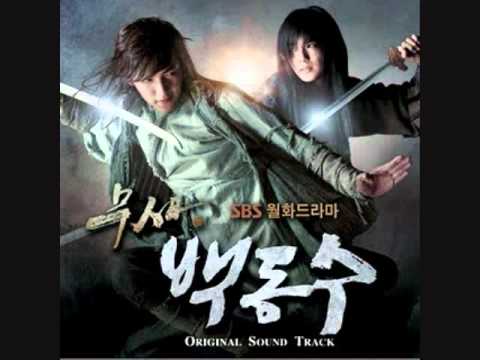
These three songs were prominently featured in the Kdrama, Warrior Baek Dong Soo.
Why I Like It
Yeah, I know I’m supposed to like that Kim Tae Woo ballad, but I like these songs from the OST. I love BMK’s voice on Yanoe, and it’s not often that you get a woman singing a powerful song, as opposed to the slow, ballad number or peppy, poppy song on a Kdrama OST. It really was used well in the Kdrama also, and really supplemented key scenes. The acoustic version by Park Eun Tae, is really nice too because it gives a completely different vibe from BMK’s version. Finally, Goyeo was another song that I really liked too. I told you, I’m contrary, I like what I like! 😀
Ever so often, I like to share what’s on heavy rotation on my iPod. It isn’t always the newest thing, or the most popular thing, but for some reason this is the stuff that I’m grooving to.
What I’m Listening To
Eoneusae Urin (Good Friends), ACHA, Super Junior (2011)
How I Came to Listen to It
I found Eoneusae Urin (Good Friends) while playing Super Junior songs on shuffle in my iTunes.
Why I Like It
It’s so happy, and I think that people forget that when they are talking smack about Super Junior. It definitely has a 1970s variety show vibe, and that’s why I like it! I think I remember reading somewhere online that it is part of the setlist for Super Show 4, so whenever SuJu decides to grace the United States, I’ll be looking forward to seeing it live. 😀
The Warring States (2011) fails on nearly every level it can: faulty plot, underdeveloped characters and a distinct lack of key elements of narrative. I know it’s tough, but I have to be honest. This is probably the worst historical film I’ve seen, because at least Three Kingdoms: Resurrection of the Dragon had Andy Lau looking fierce even as an older Zhao Zhilong.
Yeah, I know all the cool kids are into SNSD and Super Junior and BigBang and SHINee. I like them too. You get to see them doing stuff nearly every day. But it takes commitment to be a Changjo, a fan of Shinhwa, an Orange Princess.
Cassies always keep the faith and all, but try being an Orange Princess. It is no secret that I LOVE Shinhwa. How do I love thee? Let me count the ways: Andy, Eric, Dongwan, Minwoo, Hyesung, Jun Jin:
While I love the individual members of Shinhwa, you know there is always your bias. You hear that, Andy? It’s you and me, baby, YOU and ME! It’s true, I have a thing for the maknaes….
People, you have been fooled! SM Entertainment has distracted you with multi-year contracts, lawsuits and tales of exploitation, but I know what the REAL conspiracy is.
Are you ready?
SM is CLONING idols!!! YES! I am 84.7 % positive that SM has a team of scientists whose sole job is to clone idols. You haven’t noticed a slew of attractive Korean men who have cheeky cheeks and sing really well? Look!
Exhibit 1: Hye Sung of Shinhwa
Cheeky cheeks? Check! Pouty lips? Check! I suspect that Hye Sung is really the original, from which SM is taking genetic material for other idols. He is quiet and seems fairly sweet, and some have referred to him as a prince. These are things we will encounter with the clones. Oh, and let’s not forget about his singing ability!
So, Nabi has given you a pretty good overview of the book and our general observations of it. Chapter 2 includes Sun Jung’s reading of the masculinity represented by Bae Yong Joon. We here at KPK have pretty strong opinions because most of the time, we are fairly confident in what we’re talking about. This is the reason why I’m not going to talk about Sun Jung’s analysis of Bae Yong Joon. I haven’t seen Winter Sonata, so I can’t tell say anything about her reading of the way “middle-aged Japanese women” (her phrase) read Bae Yong Joon’s masculinity.
But that’s doesn’t mean I don’t have things to say about this chapter, because she talks about more than Bae Yong Joon…..
–KPK’s Reimagining of Eric’s intro to Shinhwa’s Crazy
“You cannot understand Kpop unless you are Korean.”
Recently, I heard this statement, in more than one place, uttered by more than one person. Not only is this perception narrow-minded and old-fashioned, it does not reflect the international reality of Kpop.
So now I’m going to tackle Sun Jung’s analysis of fan reaction to Chan-wook Park’s film, Oldboy. Basically, Sun Jung argues that, well, I’ll let her explain it…..
When a Kdrama starts, I’m sure the writers have a clear idea of who the lead character is. Sometimes, that plan goes awry, as other characters become so compelling that they come in and steal the show…..
I thought it was some bad dream. I was checking my Facebook, and saw a small, seemingly innocent post in English (that’s rare), saying that Soribada was suspending the sale of the Music Card for the Korean Soribada site. I just sat looking at the screen screaming, “NNNNNNOOOOOOOOOOOOOOOOOOOOOOO!” Sure enough, this is what you get when you now to go the Soribada Music Card Foreigner Site: http://www.soribada.com/foreigner/index.php



 It seems almost obligatory for anyone writing about Kpop to describe it as manufactured. Critics frequently focus on Kpop idol artists, who, in addition to making music, participate in other forms of entertainment, including variety shows and Kdramas, fashion shoots, endorsements and commercial films. In some ways it make sense. Idol artists dominate Hallyu, and tend to be the most visible to audiences outside of Korea.


 High Yellow - Asian Popular Culture